



























































BaddieHub: Truths Behind the Internet System
BaddieHub is a term commonly associated with online media, trending digital content, creator culture, and social media entertainment. People searching for BaddieHub often want to learn what the platform is, what type of content is associated with it, how it works, and how it compares with other online content-sharing platforms. The name is also used in discussions about internet trends, digital creators, and the discovery of visual content online.
BaddieHub is often discussed in connection with content discovery and creator-focused media, although the available features and content may vary across websites using this name. Understanding its purpose, content categories, accessibility, and potential privacy considerations can help users make informed decisions when exploring online platforms. As with any digital service, users should verify website authenticity, protect personal information, and follow applicable copyright and online safety guidelines.
Core Hidden Truth Missing About Baddiehub
It operates through a dual-layer system that most standard explanations fail to separate properly.
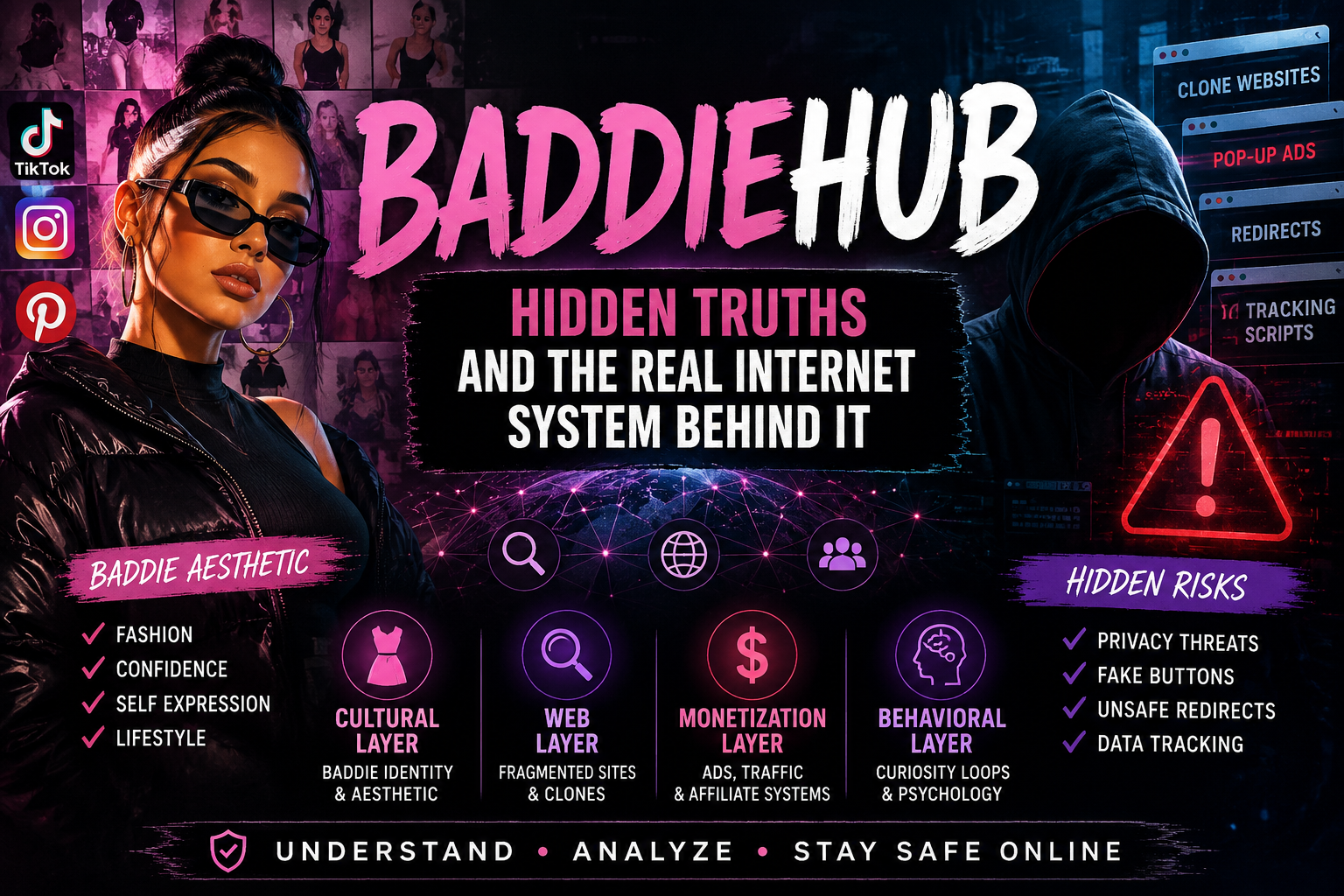
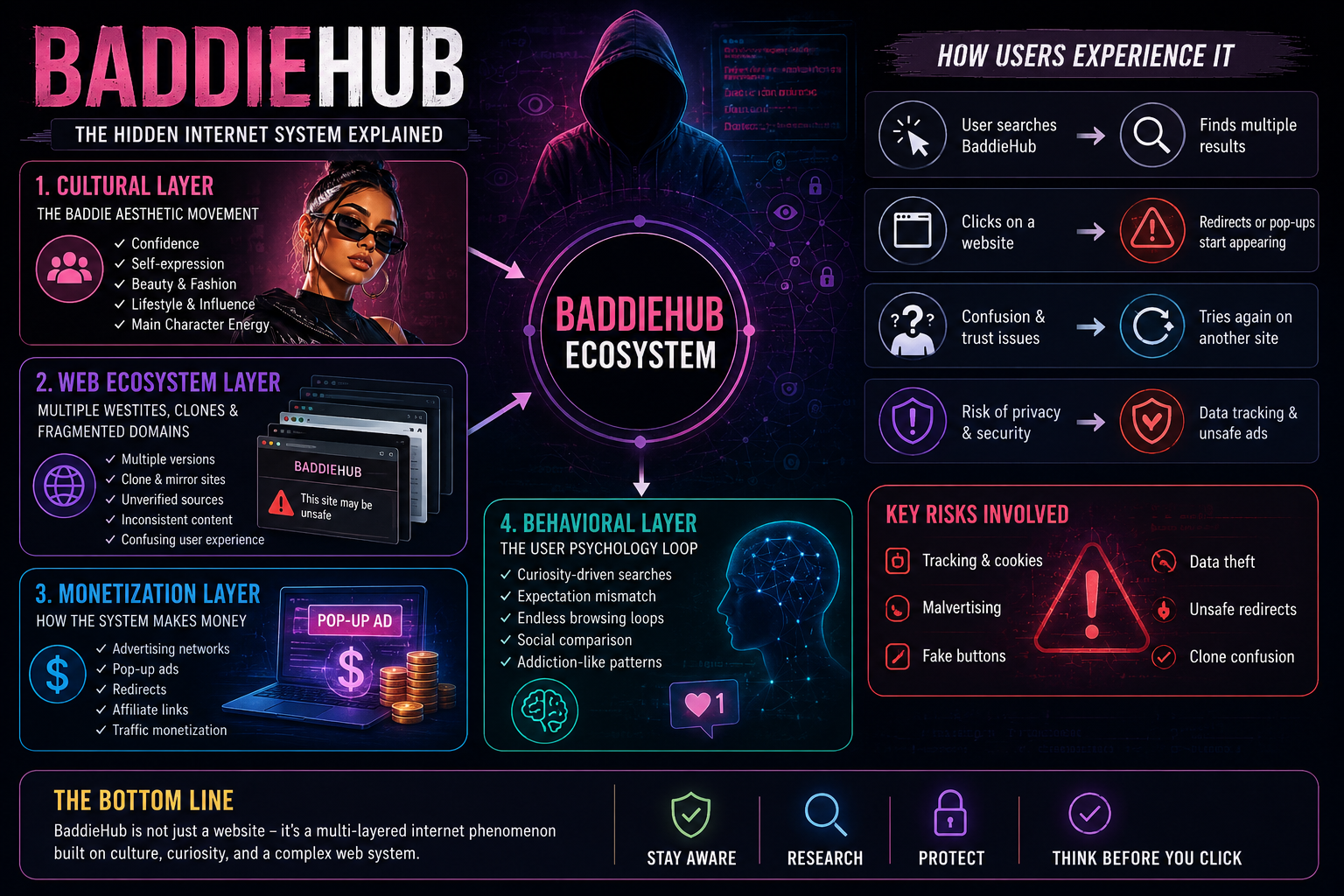
Cultural Layer (Baddie Aesthetic System)
On platforms like TikTok, Instagram, and Pinterest, Baddiehub.pro is associated with the baddie aesthetic movement, a style-driven identity built around confidence, beauty, and self-expression.
This cultural layer focuses on:
Core visual and behavioral elements include:
In this layer, Baddiehub.pro is not a website—it is a digital identity style system used to define online personality and aesthetics.
Monetization Layer
The third layer is the underlying economic system behind many websites using the keyword.
Revenue models often include:
How to Join BaddieHub
Joining BaddieHub depends on the features available on the website you visit. Follow this step-by-step guide to explore the website and create an account if registration is supported. For more information, visit BaddieHub.
Open the BaddieHub Website
Start by opening your preferred web browser on your mobile phone, tablet, or computer. Enter the address of the BaddieHub website you want to visit. Check the domain carefully before proceeding to ensure that you are accessing the intended site.
Explore the Homepage
After the website loads, explore its homepage and navigation menu. Review the available sections to understand the content and features offered. This can help you decide whether you need an account or can browse the website without registering.
Look for the Registration Option
Check the website for buttons labeled Sign Up, Register, Create Account, or Login. If a registration option is available, open it to review the account creation process. Keep in mind that some websites allow visitors to browse without creating an account.
Enter the Required Information
If the website supports registration, complete the form using the information it requests. Depending on its requirements, you may need to provide an email address, choose a username, and create a strong password. Avoid providing unnecessary personal details.
Verify Your Account if Required
Some websites ask new users to confirm their email address or complete another verification step. If this requirement appears, follow the instructions provided by the website. Never share verification codes or passwords with strangers.
Explore the Available Features
Once your account is ready, review the available sections, navigation options, and account settings. The features you can access will depend on the particular website and its current functionality. Do not assume that every site using the BaddieHub name offers the same services.
Protect Your Privacy and Security
Before using the website regularly, review its privacy policy and terms of service. Use a unique password if you register, avoid suspicious downloads, and be careful with unfamiliar advertisements or redirects. Only share personal information when you understand how it may be used.
Why People Search “BaddieHub”
Users searching Baddiehub.pro are rarely looking for a single definition. Instead, they experience intent confusion, meaning multiple expectations collide in one search term.
Common user questions include:
BaddieHub Fashion is a Visibility System
Fashion is not only about clothing or style. It works like a visibility system where outfits are designed to get attention online. The focus is on how fast someone gets noticed on social media rather than just personal fashion taste.
Designed for Camera Appearance
This fashion style is mainly created for camera use, not real-life settings. People choose outfits based on how they look in photos, videos, and front cameras. Lighting, angles, and screen appearance matter more than real-world dressing.
Scroll-Stop Effect in Styling
A key idea in this trend is “scroll-stop power.” Outfits are chosen to make people stop while scrolling on social media. This is why bold colors, tight fits, and strong visual contrast are commonly used.
Hidden Standard Look Formula of BaddieHub
Even though it looks unique, most baddiehub pro fashion follows a similar pattern. Makeup, poses, and outfit styles often repeat a fixed formula that is optimized for online attention and engagement.
Built Around Glow-Up Culture
This fashion trend is strongly connected to glow-up transformations. People show “before and after” looks, which makes the style more popular. The idea of transformation keeps the trend constantly active online.
Real User Experience Problems About BaddieHub
Interface vs Behavior Mismatch
At first glance, many sites appear clean and functional. However, after interaction:
This creates a mismatch between appearance and actual behavior.
Fake Buttons & Misleading UI Patterns
Many interfaces include elements designed to confuse user interaction:
Browser Warning:
Users often encounter security warnings such as:
However, these are often triggered by:
Important Note:
These warnings do not always indicate direct malware but often signal unsafe advertising ecosystems.
Clone Confusion Issue
One of the biggest problems is the lack of a verified source.
Users cannot reliably distinguish between:
Key Insight:
The absence of a central authority creates a trust vacuum.
Understanding BaddieHub Search Variations
All these terms like baddieshub, baddie hub, baddie hub.pro, baddiehib, baddiehu, baddiehub .pro, baddiehuh, baddie hub pro, and baddies hub are mainly different spellings and typo variations of the same keyword. Users type them in different ways because they either don’t know the exact spelling or are quickly searching without precision. Despite the differences in spelling, the intent behind all these searches is mostly the same — people are trying to find BaddieHub-related content, trends, or information connected to the “baddie” aesthetic or online media ecosystem.
Key Search Behavior Insights
Some variations like baddiehub. or baddiehub.. come from incomplete typing or accidental punctuation, but they still point toward the same search goal. The term baddiehub shutdown reflects a different type of intent, where users are trying to confirm whether the platform is working, has been removed, or changed domains, showing confusion about its availability. Meanwhile, searches like baddiehub fashion represent interest in the style and aesthetic side of the trend, focusing on outfits, beauty, and the “baddie” look.
Other terms like baddiehub ebony indicate more specific curiosity where users are trying to find categorized or niche-related content within the same keyword space.
Advantages vs Disadvantages of BaddieHub
To understand BaddieHub fairly, it is important to separate user benefits from structural risks.
| Advantages | Disadvantages |
| Users can quickly find popular or widely shared content without complex search steps or restrictions. | There is often no clear ownership, verified company identity, or official platform authority, making it difficult to judge credibility. |
| Many versions allow instant browsing without registration, reducing friction for new users and saving time. | Heavy use of pop-ups, redirects, and third-party ads can interrupt the browsing experience and reduce usability. |
| Pages are often designed to load quickly for immediate content access, especially on lightweight layouts. | Some systems may collect user behavior data through cookies, scripts, or third-party services without clear disclosure. |
| Large collections of media or aggregated content make it easy for users to browse continuously without limited selection. | Multiple duplicate or fake versions of the same keyword-based sites make it hard to identify safe or original sources. |
| Interfaces are usually minimal, allowing users to browse categories or content quickly without complex menus. | No customer support system, verified help center, or accountable management structure exists for users to rely on. |
Information about BaddieHub Changes Across Platforms
Unlike established topics with stable definitions, the meaning of BaddieHub changes depending on where it is being discussed.
For example:
This constantly changing context means no fixed definition remains accurate everywhere.
The Internet Treats It Differently in Different Places
Another reason for confusion is that the keyword behaves differently across platforms.
On one platform, it may be associated with creator culture and aesthetics.
On another, it may be linked to content-sharing sites or online communities.
Because the same keyword exists in multiple digital environments, users often receive different answers depending on where they look.
Why AI Systems Struggle With It
AI systems work best when a topic has:
BaddieHub lacks many of these characteristics.
Instead, it exists as a collection of overlapping meanings, communities, trends, and websites. This makes it difficult for AI-generated summaries to provide a complete picture without oversimplifying the topic.
Why BaddieHub Became So Popular
Its popularity is largely driven by internet trends, user curiosity, and viral content rather than a single platform or brand. Its growth follows several common digital patterns that help keywords spread rapidly across social media and search engines.
Viral Exposure Through Short-Form Content
Short-form platforms like TikTok, Instagram Reels, and YouTube Shorts helped increase awareness of the keyword. As creators mentioned or referenced BaddieHub, viewers became curious and searched for it themselves, creating a cycle of growing visibility.
Curiosity-Driven Search Behavior
Many people search for it simply because they have heard the name but do not fully understand what it is. Users often want answers to questions such as:
This curiosity generates large amounts of search traffic.
Meme and Trend Amplification
Once a keyword starts trending, it spreads through memes, social media discussions, comment sections, and online communities. Repeated exposure makes more people interested in learning about it, which further increases its popularity.
Comparison of BaddieHub with Other Platforms
Each of these platforms is built around a different way of creating, sharing, and discovering content. Here is a quick look at what distinguishes them from one another.
A centralized platform for sharing photos, videos, and short updates.
- Profiles, followers, and creator accounts
- Feeds, Reels, Stories, and discovery tools
- Published community standards and reporting tools
More about Instagram
Instagram launched in 2010 and is owned by Meta. It combines a photo-and-video feed with Stories that disappear after 24 hours and Reels for short-form video.
- Owner
- Meta Platforms
- Launched
- 2010
- Core formats
- Feed, Stories, Reels
- Good for
- Visual creators and brands
TikTok
A video-sharing platform built around trends and recommendations.
- Short videos and creator uploads
- Personalized recommendation feeds
- Creator tools and social interactions
More about TikTok
TikTok is owned by ByteDance and grew out of the 2018 merger with Musical.ly. Its For You feed surfaces short vertical videos based on watch behaviour rather than who you follow.
- Owner
- ByteDance
- Launched
- 2016 (global 2018)
- Core formats
- Short video, LIVE
- Good for
- Trends and entertainment
A visual discovery platform for ideas and inspiration.
- Organized boards and saved Pins
- Fashion, beauty, and lifestyle inspiration
- Search and visual discovery features
More about Pinterest
Pinterest works more like a visual search engine than a social feed. People save images and ideas to boards, and the platform is widely used for planning projects, outfits, and purchases.
- Owner
- Pinterest, Inc.
- Launched
- 2010
- Core formats
- Pins, boards, Idea Pins
- Good for
- Inspiration and planning
A discussion platform built around topic-based communities.
- Subreddits and discussion threads
- Voting and community participation
- Community-specific moderation
More about Reddit
Reddit is made up of thousands of independent communities called subreddits. Posts are ranked by votes, and each community sets its own moderation rules, culture, and posting guidelines.
- Owner
- Reddit, Inc.
- Launched
- 2005
- Core formats
- Posts, comments, votes
- Good for
- Discussion and niche topics
Legal & Ethical Complexity of Baddiehub
The legal and ethical dimension of it is often simplified in surface-level explanations, but in reality, it involves multiple overlapping legal gray zones depending on how the baddiehub .pro ecosystem is used and where it operates.
Copyright Concerns in Aggregated Content Systems
One of the biggest issues is content ownership.
In many web-based ecosystems associated with this keyword:
Content Redistribution Without Consent Risks
A major ethical concern is the lack of consent transparency in content circulation systems.
This includes:
Hidden Problem:
Once content enters these cycles, it becomes extremely difficult to track or remove completely.
Regional Legal Restrictions Vary by Jurisdiction
The legality of content or access tied to BaddieHub-related ecosystems depends heavily on:
Important Insight:
What is accessible in one region may be restricted or blocked in another, creating a fragmented legal environment globally.
The Future Vision of BaddieHub
The future of it will likely depend on how the keyword continues evolving across culture, technology, and online communities. Rather than developing as a single platform, it is expected to remain a dynamic digital concept influenced by changing user behavior, social media trends, and internet ecosystems.
Greater Focus on Creator Culture
As influencer marketing and personal branding continue to grow, the “baddie” identity is likely to become more connected with content creation, entrepreneurship, and digital influence. Future discussions around BaddieHub may focus less on aesthetics alone and more on creator empowerment, audience building, and online visibility.
Expansion Beyond Fashion and Beauty
While the term is strongly associated with fashion, beauty, and lifestyle content today, future usage may expand into areas such as:
This evolution could transform the concept from a visual trend into a broader lifestyle and identity movement.
BaddieHub Increased Attention to Privacy and Trust
As users become more aware of online privacy risks, there will likely be greater demand for transparency, verified information, and safer browsing environments. Future platforms or communities associated with the keyword may need stronger trust frameworks, clearer ownership structures, and improved user protection systems.
Stronger Community-Based Engagement
The future internet is increasingly moving toward niche communities rather than broad audiences. As a result, BaddieHub-related spaces may become more community-focused, allowing users with shared interests in fashion, confidence, lifestyle, and creator culture to connect more directly.
Conclusion
It is far more complex than most online explanations suggest. Rather than being a single website, platform, or brand, it exists as a multi-layered digital phenomenon that combines internet culture, social media trends, user curiosity, and a network of web properties using the same keyword. This is why so many people struggle to find a clear answer when searching for it.
Understanding BaddieHub requires looking beyond simple definitions. Its popularity is driven by viral exposure, curiosity-based searches, and evolving online discussions that continue to reshape its meaning. At the same time, users should be aware of the challenges associated with the keyword, including clone sites, privacy concerns, transparency issues, and confusion caused by its multiple interpretations.
The most important takeaway is that it should not be viewed as a fixed topic. It is a constantly evolving digital ecosystem whose meaning depends on where, how, and why it is being discussed. By understanding its cultural, behavioral, and web-based layers, users can navigate the topic more critically and avoid the confusion that often surrounds it online.
FAQs About BaddieHub
Is it actually one website or multiple different platforms?
It is not a single official website. It exists as a mixed keyword used by different websites, social media trends, and unrelated web pages. This is why users often see different versions with different behavior, design, and content.
Why does BaddieHub look different every time I search it?
Because there is no central platform controlling it. Different sites use the same keyword for traffic, so design, content, and safety levels vary widely. This creates a “changing identity” effect for users.
Why do some pages open safely while others feel risky?
The keyword is used by multiple independent websites. Some are simple content pages, while others rely heavily on ads, redirects, or third-party scripts. The experience depends on which version you land on.
Is there a real official BaddieHub or verified source?
No verified company, brand, or official authority controls it. This lack of ownership is the main reason users struggle to identify what is real or fake.
Why do I get redirected when I click anything on BaddieHub-like sites?
Many versions of these sites rely on external ad systems. Click actions may trigger hidden redirects or open third-party pages instead of performing the expected action.
Why do people search this even when they don’t know what it is?
Most users search it out of curiosity after seeing it on social media, comments, or viral mentions. It creates an “intent gap” where users are unsure whether it is a trend, website, or concept.
Disclaimer
The content published on BaddieHub.pro is intended for informational and educational purposes only. We do not guarantee the accuracy or completeness of the information provided on this website.
We are not responsible for any loss or damage resulting from the use of our content or external links. Visitors should verify information independently before relying on it.
By using our website, you agree to access and use the information at your own discretion and risk.